
The Business Case for Expectation Chains
Introduction
Implementing Expectation Chains in a company is less about buying a monitoring platform and more about adopting a management system for promises: explicit, measurable commitments that link customer outcomes to the internal capabilities that deliver them. The result is a lower cost of operations, improved customer, and a better employee work experience managing systems at scale. The core move is to stop treating “availability,” “quality,” and “speed” as generic system properties and instead define them as expectations that exist between a consumer and a provider—then connect those expectations into a chain that mirrors how value actually flows through the business.
Start with value: define a small set of customer-facing expectations
A practical rollout begins with two or three customer outcomes that executives already care about—for example “customers can complete checkout,” “customers can log in and reach their dashboard,” or “clients can submit and retrieve data through the API.” These are not slogans. They become precise expectations with thresholds that leadership can defend and fund.
Expectation Chains benefit from the service-level vocabulary popularized in Site Reliability Engineering: service level indicators (SLIs) are the measured signals, and service level objectives (SLOs) are the target ranges for those signals (Google SRE, n.d.). SLOs force useful specificity: “Checkout succeeds” is not measured by CPU utilization; it is measured by whether well-formed checkout requests succeed, whether the right totals are computed, and whether the user experience meets a time window.
For business and technical leadership, the key is to express each expectation along three axes that are easy to reason about:
- Availability: can the consumer access the service?
- Reliability: does the service produce the correct outcome for the input?
- Performance: does it meet the time window that makes it valuable?
This tri-axis framing aligns naturally to SLI/SLO practice, where teams typically track availability (successful requests), error rate, and latency distributions (Google SRE, n.d.).
Example 1: An e-commerce “Checkout” expectation chain
Consider a retail company with an online store. Leadership cares about conversion rate and revenue, but the operational question is: What must be true for checkout to be successful? A top-level expectation might be:
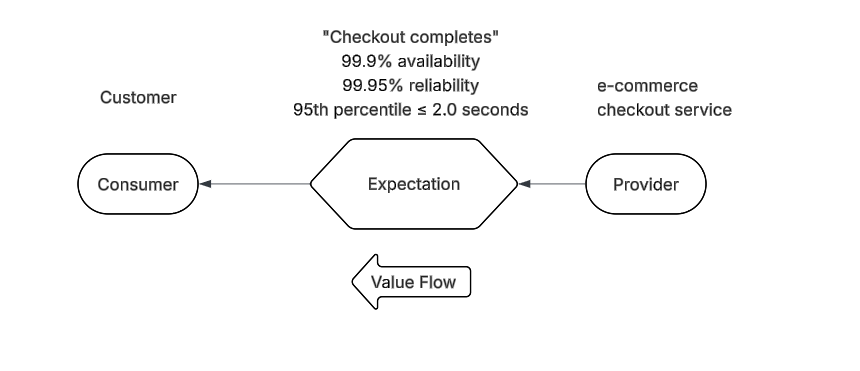
Customer ← Expectation: “Checkout completes” ← Checkout Service
- Availability SLO: 99.9% of checkout attempts receive a valid response
- Reliability SLO: 99.95% of completed checkouts have correct totals and tax/shipping rules applied
- Performance SLO: 95th percentile end-to-end checkout completion ≤ 2.0 seconds
From there, the company decomposes this into direct dependencies (not “everything in the stack,” only what checkout actually needs). For example:
-
Checkout Service depends on:
- Cart/Pricing Service
- Inventory/Reservation Service
- Payments Gateway Adapter
- Fraud/Risk Service
- Order Database
Each dependency becomes its own expectation node, owned by the provider team. This is the governance advantage of Expectation Chains: the chain makes “who owes what to whom” explicit, and leadership can see how reliability is assembled from smaller commitments rather than argued about after an incident.
Turn expectations into operational controls using error budgets
Once SLOs exist, the company needs a mechanism to make them actionable. Error budgets are a widely used control: the “budget” is the allowed failure rate implied by the SLO, and it becomes a shared decision tool for balancing feature velocity and operational stability (Thurgood, 2018). In Google’s published example policy, teams continue normal releases when they are within SLO, but when the error budget is exceeded, they halt most releases to prioritize reliability work until the service returns to compliance (Thurgood, 2018). That policy structure is extremely useful for leadership because it replaces subjective debates (“are we stable enough?”) with an agreed rule.
Applied to the checkout chain, a leadership-aligned policy might look like:
- If Checkout is within error budget, the feature roadmap proceeds.
-
If Checkout exceeds budget over a rolling four-week window, deployment approvals tighten:
- Only P0 fixes, security fixes, and reliability work ship.
- All other changes require explicit exception approval.
- This aligns incentives across product, engineering, and operations while preserving business intent: improve outcomes, not just reduce alerts.
Instrumentation: measure the expectation, not the infrastructure
Expectation Chains fail if teams instrument only component health (CPU, memory) but not user outcomes. For each expectation, the company implements probes that answer: did we meet Availability, Reliability, and Performance for this interaction? That can include synthetic transactions (robot checkouts), real user monitoring (browser timing), and server-side indicators (successful request ratio and latency percentiles).
OpenTelemetry is often a practical standard for building this instrumentation layer because it provides a vendor-neutral collection and export of traces, metrics, and logs (OpenTelemetry, n.d.). The OpenTelemetry Collector, in particular, is designed as a unifying pipeline that can receive telemetry, process it, and export to one or more backends—helpful when organizations want consistent measurement without immediate vendor lock-in (OpenTelemetry, 2025).
For the checkout example, the company typically instruments:
- A trace that begins at the browser or edge and crosses Checkout → Pricing → Inventory → Payments → DB
- A metric that counts successful checkout completions and failures by reason
- A latency metric (e.g., p95/p99) for end-to-end and per-dependency timing
- A correctness signal (e.g., validation that the order total and tax rules match policy)
The principle is that each expectation has explicit evidence for the three axes, enabling a pass/fail rollup aligned to business meaning.
Aggregation: chains and pools behave differently
A chain is not a dashboard. It is a logical structure for deciding whether the customer-facing expectation is being met. In a strict dependency chain, a failure in a required child expectation compromises the parent expectation. However, modern systems have redundancy: a pool of database replicas, a fleet of API instances, multiple payment processors. Pool-level expectations must model capacity and quorum, not binary “up/down.”
This is where leadership benefits from a more realistic story than classic uptime metrics. If only 70% of a serving fleet is healthy, the customer experience may be fine today but fragile under load tomorrow. Expectation Chains make it natural to define pool expectations like:
- “At least 90% of serving instances meet p95 latency ≤ 200 ms”
- “At least N units of capacity are available to sustain peak hour traffic”
- “Quorum reads/writes succeed within threshold”
This gives executives early warning signals that are still tied to customer impact, rather than infrastructure trivia.
Example 2: a B2B SaaS API expectation chain
For a B2B platform, customer expectations often center on API reliability and predictability. A top-level expectation might be:
Client Application ← “CreateRecord API succeeds” ← Public API
-
- Availability: 99.95% successful responses for well-formed requests
- Reliability: no duplicate records; idempotency honored; schema constraints enforced
- Performance: p95 ≤ 300 ms for standard payload sizes
Dependencies might include:
- Authentication/Authorization service
- Rate limiting / API gateway policy engine
- Primary datastore
- Event bus for downstream processing
- Notification service (optional)
In this setting, Expectation Chains also support contract clarity. If “CreateRecord” is fast but downstream “SearchIndex updated” lags, leadership can decide whether that lag violates a customer promise or remains best-effort. Expectation Chains encourage making those distinctions explicit so that sales promises, contracts, and engineering reality match.
Integrate incident response and security expectations
Expectation Chains become operationally meaningful when they shape incident response. ITIL’s incident management guidance emphasizes minimizing negative impact by restoring normal service operation as quickly as possible and notes that quick restoration directly affects satisfaction and provider credibility (AXELOS, 2020). Expectation Chains operationalize this by ensuring that when a customer-facing expectation fails, the organization can immediately see the most likely failing child expectation and route response to the team that owns it.
Security incidents can be modeled similarly. NIST emphasizes that effective incident response requires planning and resources and provides structured guidance for handling incidents efficiently and effectively (Cichonski et al., 2012). In practice, leadership can define expectations such as:
- “Critical security alerts are triaged within 15 minutes”
- “Containment for confirmed credential compromise begins within 60 minutes”
- “Customer-impacting security incidents receive executive communication updates every 60 minutes”
These are not merely policy statements; they are measurable expectations supported by logs, workflow timestamps, and on-call telemetry. This allows security operations to be governed with the same rigor as product reliability.
Tie Expectation Chains to delivery performance and governance
Expectation Chains gain executive buy-in when they connect reliability work to delivery outcomes. DORA’s “four keys” provide a well-known set of delivery performance measures: deployment frequency, change lead time, change failure percentage, and failed deployment recovery time (DORA, n.d.). A mature Expectation Chains program uses these metrics to demonstrate that reliability discipline is not inherently the enemy of speed; instead, the organization can track whether changes are becoming safer and recoveries faster while customer expectations remain satisfied (DORA, n.d.).
A concrete governance pattern looks like:
- Every critical expectation has an owner, SLOs, and an error budget policy.
- Every production change declares which expectations it could affect.
- Post-release, the company reviews expectation health deltas and ties incidents back to breached expectations.
- Quarterly planning allocates capacity to expectations that repeatedly threaten customer outcomes.
This turns observability from a reactive, tool-driven activity into an operating model for delivering value predictably.
A realistic adoption path
Most companies implement Expectation Chains in phases:
- Define top-level customer expectations for one revenue-critical journey.
- Map direct dependencies and assign ownership for each child expectation.
- Instrument outcome-based signals (synthetics, traces, key correctness metrics).
- Establish error budget rules and integrate them into release governance (Thurgood, 2018).
- Expand recursively into deeper layers (data, vendors, teams) once the first chain reliably supports decisions.
This approach avoids the common trap of “boil the ocean observability.” Instead, the organization earns trust by making a small number of customer-facing expectations measurable and governable, then scaling the pattern.
References
AXELOS. (2020). Incident management: ITIL® 4 practice guide (11 January 2020). https://s3.amazonaws.com/thinkific/file_uploads/381835/attachments/aba/2cf/226/Incident-management.pdf
Cichonski, P., Millar, T., Grance, T., & Scarfone, K. (2012). Computer security incident handling guide (SP 800-61 Rev. 2). National Institute of Standards and Technology. https://doi.org/10.6028/NIST.SP.800-61r2
DORA. (n.d.). DORA’s software delivery metrics: The four keys. https://dora.dev/guides/dora-metrics-four-keys/
Google SRE. (n.d.). Service level objectives. https://sre.google/sre-book/service-level-objectives/
OpenTelemetry. (n.d.). Documentation. https://opentelemetry.io/docs/
OpenTelemetry. (2025). Collector. https://opentelemetry.io/docs/collector/
Thurgood, S. (2018, February 19). Example error budget policy. In The site reliability workbook. https://sre.google/workbook/error-budget-policy/